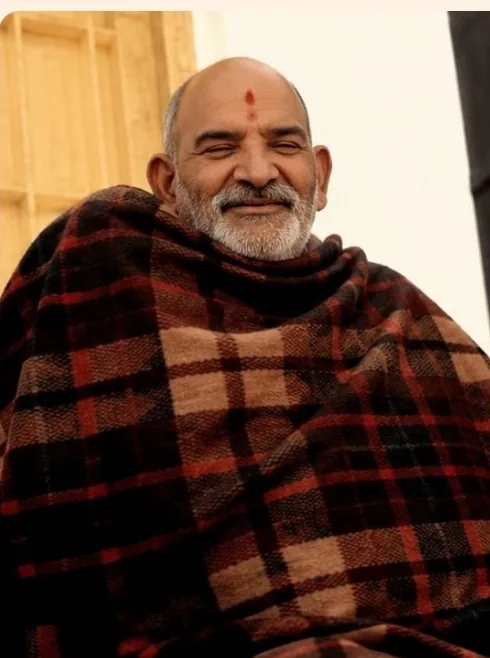
The saint in brief
Neem Karoli Baba was born around 1900 in Akbarpur, in present-day Uttar Pradesh, according to Wikipedia. He left home as a young man and wandered northern India as a sadhu, taking different names along the way, from Lakshman Das to Tallaiya Baba. The name by which most of the world knows him comes from the village of Neeb Karori, where he stayed in the 1930s. To his devotees he is simply Maharaj-ji. The names, and what they mean, are covered in why Neem Karoli Baba is called Maharaj-ji.
The village that gave him a name
The devotee site maharajji.love says villagers in Neeb Karori knew him by that name during the 1930s and that the village became famous after an incident on a train. According to the same source, a railway flag station there was later named after Lakshmandas Puri. A press note carried by The Tribune records another name, Kambal Wale Baba, the baba of the blanket, and gives his birth name as Lakshmi Narayan Sharma. The blanket also gives the photograph pair on The Film page its caption, 'Same blanket, same blessings'.
Devotion to Hanuman
Above every other devotion he loved Hanuman. He founded the ashram at Kainchi Dham in the Kumaon hills in 1964, with a Hanuman temple at its centre, and Wikipedia records that more than a hundred temples were built in his name. Kainchi Dham still draws thousands of seekers every year, and an annual fair is held there on 15 June. He died in Vrindavan on 11 September 1973. According to Wikipedia, he was returning by train from Agra to Kainchi when he fell ill at Mathura station, and he died in a hospital in Vrindavan. His samadhi in Vrindavan is where the first poster of the film was unveiled.
Two details of that ashram matter for the film. The Hanuman temple at Kainchi Dham is its centre, and the annual fair on 15 June draws devotees from across India and abroad. Anupriya Nagar, who has been there twice, described the ashram to the press as a place that matters to devotees well beyond religious faith.
The teaching that fits in a breath
He kept almost nothing, wrote almost nothing and gave no long sermons. His whole teaching is remembered in one line: love everyone, feed everyone, serve everyone, remember God. The film's makers put it in nearly the same words in their press release: love all, serve all, feed all and remember Ram, as ANI reported. People who sat with him rarely remembered his words afterwards. What they remembered was how they felt: lighter, seen, and quietly changed.
That is why the film's makers say it is not built on miracles. Director Vishal Chaturvedi has said the film is about human emotions, devotion and service, and that it shows how a saint can bring lasting change through compassion. The press note carried by The Tribune quotes him as saying the saint never delivered a lecture and never showcased a miracle.
Four instructions, four ways of living
The one-line teaching is easy to remember and harder to follow. Love everyone is the plainest of the four. Feed everyone is the most concrete, and it is the part the director has singled out: Chaturvedi told ANI that the film emphasises the saint's attention to feeding the hungry and caring for people on the margins of society. Serve everyone is seva, the word Anupriya Nagar uses for the thread that runs through her own life, from fundraising at Bath to the film. Remember God is the quiet centre of it, and the reason the makers describe the film as centred on Ram Naam and Hanuman bhakti.
How his story travelled
Wikipedia records Ram Dass and Larry Brilliant as his disciples, who after returning to the United States founded the Seva Foundation, a health organisation in Berkeley, California. The kirtan singer Krishna Das is also recorded as his devotee, and has written about him in the memoir Chants of a Lifetime. Krishna Das sings two chants in the film. Steve Jobs is widely reported to have travelled to India hoping to find the saint, and press reports link Mark Zuckerberg and other well-known figures to a visit to Kainchi Dham. DNA India carried the trailer launch under a headline naming several of them. Those accounts come from news reports and biographies, and the saint himself never sought a following.
Where the film came from
The film began when producer Anupriya Nagar, then in her final year of an Economics degree at Bath, read an article about the saint and Steve Jobs. Aaj Tak reports that she first heard about him from a foreigner, and felt embarrassed that she, as a young Indian, had not learned about such a great spiritual figure from her own sources. That feeling shaped her aim: to bring his story to Gen Z. She says she did not choose the story: "I did not choose this story. It chose me." The research, the book Divine Detour and the team's year of preparation are covered in how Hanuman Ansh was made.
What the film shows
According to the makers, Hanuman Ansh follows a young seeker who leaves Braj in search of Ram. The story moves through forests, temples and villages in pre-Independence India, and is centred on Ram Naam, Hanuman bhakti, seva, surrender and spiritual awakening. It shows how the saint's quiet presence and simple message change the lives of the people he meets. Shobhinaw Satyaa plays Neem Karoli Baba.
The makers have said the film differs from earlier works on the saint, which focused on his Western devotees, by looking at his early life in India. Chaturvedi told ANI that villagers in Neeb Karori described the saint as an "Anshik" form of Hanuman, a partial form, which is the idea behind the title.
Why now: a story for a young generation
Chaturvedi has said most of the saint's devotees today are Gen Z, and that good music and storytelling can reach them without losing the spiritual essence. Anupriya Nagar makes a similar point: the film is for her generation and younger viewers, not only for devotees, and its core is spirituality, teaching, and relationships between friends or between a teacher and a student. She told Global Indian that early screenings moved audiences. The wager of the film is that a story of devotion, told honestly and beautifully, can speak to a young person scrolling at midnight as much as to a lifelong devotee, and the film's reception is covered in the box office explainer.
From the screen to the ashram
Anupriya has visited the places in the film's story. She went to Kainchi Dham on 13 September 2026 with her family and colleagues, and described it to the press as a sacred place for devotees from across India and abroad, not only a centre of religious faith (Aaj Tak, Khabar Digital). Global Indian reported that she visited twice in two months during production. In Vrindavan on 9 September she took the blessings of Premanand Ji Maharaj (Navbharat Live). Of that meeting she says: "Some moments stay with you for the rest of your life. This is one of mine."
Reverence in the telling
A film about a saint carries a particular duty, and the makers have spoken about it. Anupriya has said that devotional films must be made authentically and with real effort, and that the team treated the story as a calling rather than a commercial project. Before work began they completed forty-three days of the Hanuman Chalisa. She has also said she would like people who watch the film to go on to learn about him and to visit his ashram, which Amar Ujala reports as the message she hopes the film carries.
How the saint appears in the film
Playing a saint on screen is a delicate task. Shobhinaw Satyaa plays Neem Karoli Baba, with Chandan Anand, Purnima Tiwari, Vihaan Shedge, Anil Rastogi and Gulshan Pandey in the cast. The music includes ten original songs, among them two chants sung by Krishna Das, and the makers say they used VFX in only two or three scenes. Chaturvedi's stated approach is to keep human emotion, not spectacle, at the centre.
Three common misunderstandings
- That the film is about miracles. The director has said plainly that it is not a miracle film. It is built around human emotion, devotion and service, and the saint's own way of teaching, which, as the press note puts it, involved no lectures and no display of miracles.
- That his name refers to a neem tree. The devotee site traces the name to the village of Neeb Karori, and says the spelling 'Neem Karoli' is a later drift, as covered in the article on his names.
- That his story is mainly a Western one. Many people meet him through well-known foreign devotees. The makers say they wanted to look instead at his early life in India, his childhood, his wandering years and the people who knew him there.
How to approach the film if you are new to him
You do not need to know the saint to watch the film. The makers say it is made for a young audience as well as lifelong devotees, and that the story is told through a young seeker's eyes, so you learn what he learns. If it leaves you curious, three routes lead further: the book Divine Detour by Vishal Chaturvedi, from which the film was adapted; the memoir Chants of a Lifetime by Krishna Das, who also sings in the film; and, for those who can travel, a visit to Kainchi Dham. This site's film page lists the cast, credits and sources, and the media page collects press coverage.
Further reading
- Neem Karoli Baba on Wikipedia
- What About Maharajji's Names? on maharajji.love
- ANI: director Vishal Chaturvedi on the concept
- DNA India: the trailer launch
- The Film page and the press page
Biographical details come from Wikipedia, a devotee-run site and press reports, and differ slightly between sources. Where they disagree, this page avoids stating a single version.
Frequently asked questions
Who was Neem Karoli Baba?
Neem Karoli Baba, known to devotees as Maharaj-ji, was an Indian Hindu saint devoted to Hanuman. He founded the ashram at Kainchi Dham in the Kumaon hills in 1964 and died in Vrindavan on 11 September 1973.
What was Neem Karoli Baba's main teaching?
He is remembered for a one-line teaching: love everyone, feed everyone, serve everyone, remember God. He wrote almost nothing and gave no long sermons.
Where is Kainchi Dham?
Kainchi Dham is the ashram in the Kumaon hills of Uttarakhand that Neem Karoli Baba founded in 1964. It has a Hanuman temple, and an annual fair is held there on 15 June.
Which famous people are linked to Neem Karoli Baba?
Ram Dass, Larry Brilliant and Krishna Das are recorded as his devotees. Steve Jobs is widely reported to have travelled to India hoping to meet him, and press reports link Mark Zuckerberg and others to Kainchi Dham.
Why is the film called Hanuman Ansh?
Ansh means a portion or part. Director Vishal Chaturvedi has said that villagers in Neeb Karori described the saint as an 'Anshik' (partial) form of Hanuman, and that the title reflects a spiritual concept rather than a claim.
Is Hanuman Ansh only for devotees?
The makers say no. Both the director and the producer have said the film is meant for a young, global audience as well as lifelong devotees.
What does the film show of his life?
According to the makers, the film follows a young seeker who leaves Braj in search of Ram, through forests, temples and villages in pre-Independence India, centred on Ram Naam, Hanuman bhakti and seva.
Where can I read more about the film's press coverage?
All coverage, with links to the original outlets, is collected on the media page of this site.