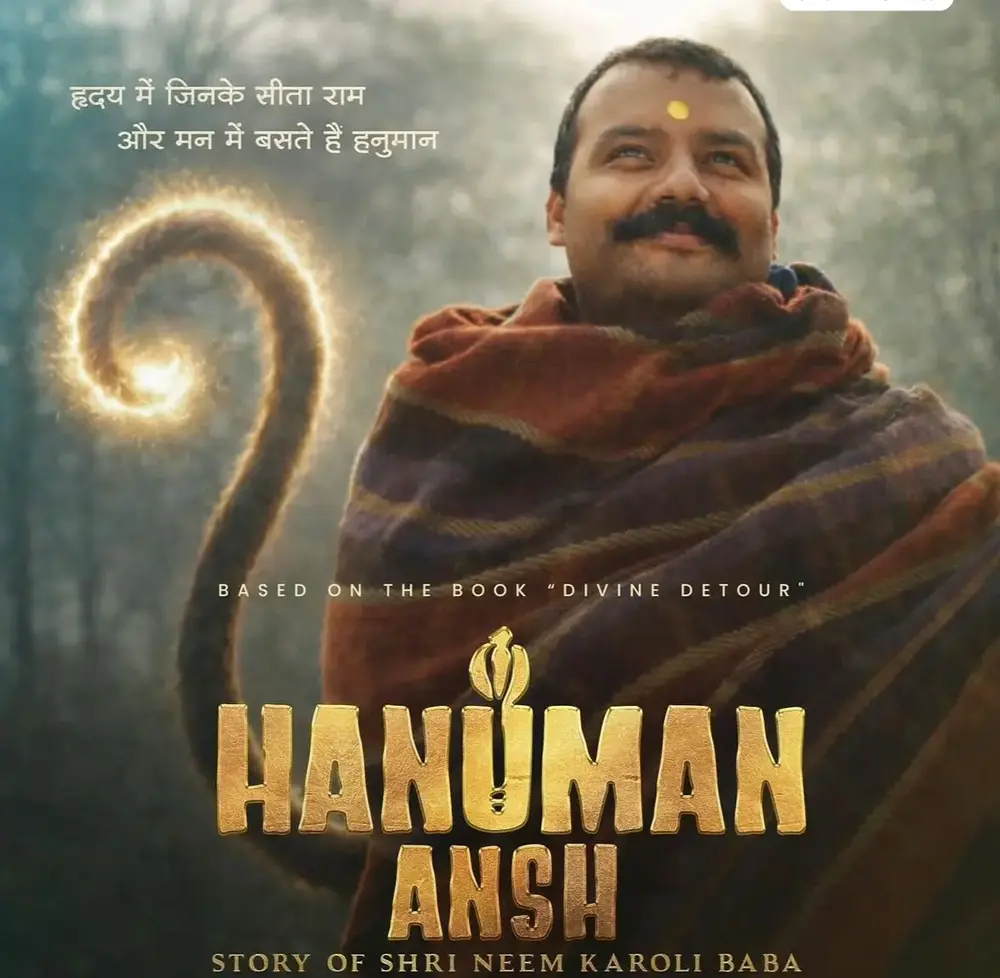
The film in brief
Hanuman Ansh follows a young seeker who leaves Braj in search of Ram and, through faith and seva, becomes Neem Karoli Baba, known to devotees as Maharaj-ji. It is written and directed by Vishal Chaturvedi and produced by Ragini Sona, Namrata G. Singh, Anupriya A. Nagar and Vishal Chaturvedi under the Swambhu Media Network banner. Cinépolis distributed it in India, and Hombale handled overseas release. It reached Indian cinemas on 7 August 2026.
It started with an article
According to a Global Indian profile of producer Anupriya Nagar, the idea began in her final year of an Economics degree at the University of Bath. She read an article claiming that Neem Karoli Baba had inspired Steve Jobs, and began to research the saint and the ashram at Kainchi Dham. Money9 adds that she was studying how the founders of major technology companies found their direction. Global Indian says her research led her to Namrata G. Singh, Ragini Sona and the writer-director Vishal Chaturvedi, and that together they spent about a year researching the saint's life, visiting places connected to him and speaking with people who knew about him.
Other outlets tell the same story from a different angle. Aaj Tak and Amar Ujala report that she returned to India in 2025 after being offered a job in Zurich, and joined the project as a producer after meeting Chaturvedi, who was already developing a film on the saint. The accounts differ in detail, but they agree on the substance: a student's research became a film.
A film that had run out of money
In the Amar Ujala interview, Anupriya says she was told that the film had been shot but that there was no money left for post-production. That is the point at which she put in her savings from three years of part-time work in the UK. She says she did not fund the whole film, and describes her share as about one-third of the total budget. The film was produced by three women, and she is the youngest of them. Aaj Tak reports that she had no film experience, and that she hoped to reach Gen Z with the saint's story.
A book before a script: Divine Detour
Chaturvedi told ANI that he researched using Indian authors, books, websites and references, interviews, and visits to places connected to the saint. He compiled that research into a book, Divine Detour, and then adapted it into the film's story. The film credits list it as the source.
Not a conventional biopic
In the same ANI report, Chaturvedi said the film is inspired by the life and legacy of Shri Neeb Karori Baba but is not a conventional biopic. It is, he said, a spiritual journey about human emotions, devotion and service, and "we haven't made a miracle film". He said the film puts weight on the saint's focus on feeding the hungry and caring for people on the margins of society.
A pre-release press note carried by The Tribune (an advertorial distributed by PNN, with the paper's disclaimer) said the film covers his formative years, including his childhood and his life as a householder, and differs from earlier works that focused on Western devotees such as Ram Dass. DNA India described a story set in pre-Independence India that moves through forests, temples and villages, centred on Ram Naam, Hanuman bhakti and seva.
Why the title is Hanuman Ansh
"Ansh" means a portion or part. Chaturvedi explained to ANI that he chose the title to point to a spiritual concept rather than to name the saint, and that he is not claiming the saint is Hanuman. Villagers in Neeb Karori, he said, told him the Baba was known as "Anshik Hanuman" or "Anshik Avatar", a partial form of Hanuman. You can read more about his names in why Neem Karoli Baba is called Maharaj-ji.
Forty-three days of the Hanuman Chalisa
Anupriya Nagar says that before the team began, they completed forty-three days of the Hanuman Chalisa, and that "wherever we went, the Chalisa came with us". Global Indian reported that this recitation took place in Chitrakoot before filming, and Aaj Tak reported that the team recited the Hanuman Chalisa on set every day during the shoot. She also visited Kainchi Dham twice within two months during production, according to Global Indian.
A devotee-led launch, not a premiere
The film's first poster was unveiled at Baba's samadhi in Vrindavan, amid the Hanuman Chalisa and a traditional bhandara, surrounded by devotees rather than press. Its Tribune press note says the journey began at Kainchi Dham, where the poster first received blessings. The official trailer followed a similar spirit. According to DNA India, it was unveiled in a worldwide, devotee-led launch at 11:11 AM, in which temples linked to Neem Karoli Baba, Hanuman temples, ashrams, schools and community groups in India, the UK, the US and Canada took part. Participants began with collective recitations of the Hanuman Chalisa and Sundarkand Path.
The cast and the crew
Shobhinaw Satyaa plays Neem Karoli Baba, with Chandan Anand, Purnima Tiwari, Vihaan Shedge, Anil Rastogi and Gulshan Pandey among the cast. Vishal Bawa is the cinematographer, Shankh Rajadhyaksha the editor and Sadhu Sushil Tiwari the composer. The film has ten original songs, including two chants by the kirtan singer Krishna Das, according to Global Indian. The same report says VFX was used in only two or three scenes and that the team chose not to train AI systems on the film's material.
In an Aaj Tak interview, Anupriya observed that people still revere the actor who played Maharaj-ji as Maharaj-ji, which she took as a sign of how seriously the team treated the role.
The budget
Global Indian reported a budget of around ₹1.75 to ₹2 crore, and Aaj Tak, Amar Ujala and Khabar Digital reported about ₹2 crore. Anupriya told Aaj Tak that a ₹10 crore film would have felt different, and that she wants to keep the same simplicity for the next one. Her share of the funding is described as about one-third of the budget by Amar Ujala. The profile of Anupriya Nagar has more on that. Global Indian noted that the financing structure has not been publicly disclosed.
A slow start, then a surge
The film opened with roughly ₹10 lakh on 7 August 2026. Shows were cut in the first week and some people wrote it off. Aaj Tak's 23 September interview says that after being written off as a flop early on, the film earned about ₹350 crore worldwide on a budget of about ₹2 crore. Anupriya credits the blessings of Neem Karoli Baba for that turn. The film's growth through word of mouth, rather than a marketing push, is also the point trade analyst Taran Adarsh made when he compared it with Jai Santoshi Maa, as IWMBuzz reported.
Keeping the telling reverent
Reverence is the principle Anupriya says the film was shaped around. In her Aaj Tak interview she said mythological and devotional films must be made authentically and with real effort, and that she would not criticise any other film. Asked about an actor changing his diet for a spiritual role, she relayed the advice of Premanand Ji Maharaj that conduct and character matter more than food alone, and that a person must stay humble even after success. She pointed to the actor who played Maharaj-ji in Hanuman Ansh, whom people still revere as Maharaj-ji, as an example of a team treating a role with respect.
The release
- 31 July 2026: the originally announced date, per the pre-release coverage.
- 7 August 2026: the film reached cinemas after the date was moved, as reported by ANI. It opened on about 355 shows, according to Global Indian.
- Through August and September: screens reportedly rose to about 1,500 as word of mouth grew. On 6 September, Global Indian reported ₹100 crore in India net within 30 days.
- 11 September 2026: the film opened in international markets through Hombale. ANI reported the global release, with trade analyst Taran Adarsh calling it "the biggest success story of 2026".
How the collections grew from there, with trackers and dates, is set out in the box office explainer. Tracker figures by day 83 (28 October 2026) showed about ₹452 crore worldwide gross per Sacnilk and about ₹442 crore per Bollywood Hungama. They are estimates, not audited accounts.
Outreach beyond cinemas
The team has taken the film to people directly. On 2 August (Friendship Day) the producers hosted a screening in Mumbai for underprivileged children and their parents from the Angel Xpress Foundation. Anupriya says she has visited more than 65 schools and universities in the UK, and she believes word of mouth carries the film further than social media. In Vrindavan on 9 September she took the blessings of Premanand Ji Maharaj and was honoured at a Ramayani Samman ceremony (Navbharat Live).
The timeline at a glance
- Final year at Bath: the research into the saint and his reported link with Steve Jobs begins.
- 2025: Anupriya returns to India, meets the director, and joins the film as a producer.
- Before filming: forty-three days of the Hanuman Chalisa, with the first poster unveiled at the samadhi in Vrindavan.
- July 2026: teaser and trailer. ANI's coverage of the director's explanation is dated 11 July.
- 7 August 2026: release in India, moved from the originally announced 31 July.
- 11 September 2026: international release through Hombale.
- Late September 2026: reported milestones of ₹300 crore India net and ₹400 crore worldwide gross.
- 28 October 2026 (day 83): tracker figures of about ₹342 crore India net and ₹452 crore worldwide gross.
What the makers want people to take away
Anupriya says she measures success by whether people learn something about the saint. She has said she would be happy if each viewer took away one new understanding of Baba from the film, and she told Amar Ujala she hopes viewers will go on to learn about his life and visit his ashram. The director's aim, as he told ANI, is a film that younger viewers feel is theirs without losing its spiritual centre, built on the saint's message of feeding the hungry and caring for those on the margins.
What comes next
Global Indian reported that Hanuman Ansh is the first part of a planned trilogy. The announcement of a sequel has been covered by the press, and the full list of articles is on the media page.
Figures and dates are as reported by the outlets linked above and may differ between outlets. Quotes from Anupriya Nagar not attributed to an outlet are from her statements on The Film page.
Frequently asked questions
What is Hanuman Ansh about?
Hanuman Ansh is a Hindi spiritual drama inspired by the life of Neem Karoli Baba. It follows a young seeker who leaves Braj in search of Ram and, through faith and seva, becomes the saint known to devotees as Maharaj-ji.
Who made Hanuman Ansh?
It was written and directed by Vishal Chaturvedi and produced by Ragini Sona, Namrata G. Singh, Anupriya A. Nagar and Vishal Chaturvedi under the Swambhu Media Network banner. India distribution was through Cinépolis and overseas distribution through Hombale.
Is Hanuman Ansh a biopic?
The director has said it is inspired by the saint's life and legacy but is not a conventional biopic, and that it is not a film built on miracles.
What is the book Divine Detour?
Divine Detour is a book by Vishal Chaturvedi that compiled his research on the saint's life. The film's story was adapted from it.
When was Hanuman Ansh released?
It was released in India on 7 August 2026, after an earlier planned date of 31 July, and opened in international markets on 11 September 2026.
What was the Hanuman Ansh budget?
Global Indian reported a budget of around ₹1.75 to ₹2 crore. Other outlets have reported about ₹2 crore.
What did the team do before filming?
Anupriya Nagar says the team completed forty-three days of the Hanuman Chalisa before starting. Global Indian places this recitation in Chitrakoot, and Aaj Tak reported that the Chalisa was recited on set daily during the shoot.
Will there be a sequel to Hanuman Ansh?
Global Indian reported that the film is the first part of a planned trilogy, and press have reported the announcement of Hanuman Ansh 2.